


CW: This essay discusses sexual assault and rape, including allegations of gang rape and descriptions of sexual violence. Please take care of yourself while reading or listening.

By now you’ve almost certainly heard about the allegations of gang rape that occurred in October 2024 at a fraternity at Cornell University, which became public after the woman identified as “Jane Doe” filed a civil lawsuit. I’m neither puzzled nor surprised that the seven members accused—and the dozens of other frat members who received a Snapchat saying “free pussy” and did nothing about it—weren’t, or were barely, held accountable1 at the time.2 The frequency with which people who commit, enable, or ignore sexual violence escape meaningful consequences is far too common to be surprising.
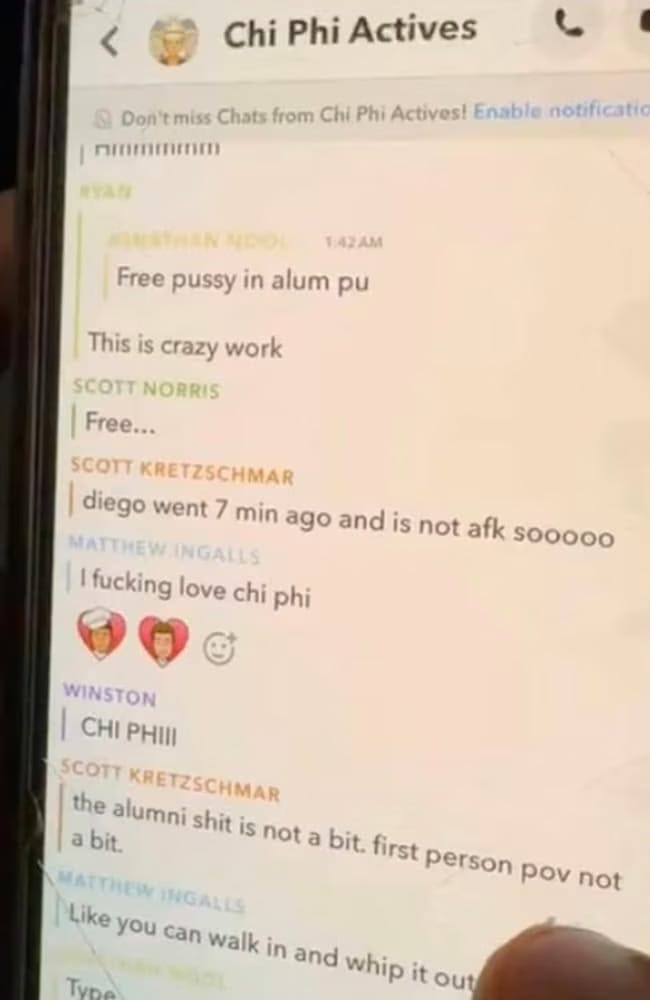
But I keep trying to wrap my mind around how these young adults could have looked at a human being passed out on the floor and decided to do what they allegedly did to her even once, let alone over and over for hours.
It’s embarrassing to admit that because I know better. I’ve been writing about rape culture, objectification, and our cultural indifference to women’s autonomy for years. I’ve written about bro culture and how mocking, insulting, or hurting women is used as a form of male bonding. Being from Montreal, I remember the horrific gang rape allegations at McGill University when I was a college student somewhere else. One of the men accused—who allegedly used a broom—was an old friend.3
I understand it intellectually but sometimes I just can’t quite get it on an emotional level. I keep wanting to say something that I know is ridiculously naive: how could someone treat another human being like they’re not one? How can they not imagine the intense harm they are committing to someone both physically and emotionally—the way they are forever changing that person’s life and her ability to feel at home in her body, to trust others, and to believe in her own agency and humanity? Not to mention the long-lasting mental health impacts such as anxiety, depression, and post-traumatic stress.
I want to know what goes on in a man’s head when he’s doing what seems to a woman like the unthinkable, especially when he does not fully register, or even agree, that he is committing a crime.
Fortunately, researchers have asked this question, too.
In 2024, a review of the literature on the perspectives of men who commit sexual violence was published. The researchers searched five databases and found 14 relevant articles representing 12 studies. Most involved incarcerated sex offenders, but the more recent studies included college students and men posting anonymously online. They identified four recurring themes4:
“She deserved it.”
“I’m a good guy.”
“I couldn’t stop myself.”
“I’m really sorry.”
Before getting into those four themes, I want to step back to a foundational study that helps answer an even more basic question: What does a perpetrator believe happened? We can’t fully understand a person's justifications until we understand the story he is telling himself about the act itself.
In this classic study from 1984, convicted, incarcerated rapists were categorized into two distinct cognitive mindsets: “Admitters” and “Deniers.”
Admitters acknowledge that they committed sexual assault and agree that the act itself is bad, but blame forces outside of their control that compel them to rape, such as past trauma or drugs and alcohol.
Deniers refuse to define their behavior as rape. Instead, they reconstruct the encounter in a way that makes it seem consensual, deserved, or not particularly serious. They rely heavily on cultural myths (e.g., women say no but really mean yes) and victim-blaming stereotypes (e.g., what she wore) to construct justifications.
So, disturbingly, whether these perpetrators admitted or denied what they did, most found ways to avoid seeing themselves as the kind of person who would commit rape. Looking more closely at the four themes that emerge when we get inside the mind of a perpetrator helps us understand how these rationalizations work.
1. She Deserved It
The strongest theme in the review was the displacement of blame onto the woman. It appeared in 13 of the 14 articles. The researchers identified four variations: she seduced me; she’s a slut; she’s a sexual object; she must be punished.
Instead of thinking, I am violating someone who doesn't want this, the perpetrator constructs a different story about the victim wanting it or causing it.
The threshold for perceived (or imagined) sexually provocative and promiscuous behavior was typically very low and included the victim being “friendly”, inviting the perpetrator to her home, drinking (“If she’s a bit tipsy, you will know the kind of person she is”), hitchhiking or accepting a ride from the perpetrator, going on a date with the perpetrator, wearing “short skirts,” and failing to resist, among others.
When it comes to objectification and punishment, a woman is experienced primarily as a body that provides sexual gratification or a release of hostility. Her desires and feelings become psychologically irrelevant. He doesn’t have to consciously think, she isn’t human. He just has to stop thinking about her humanity which then prevents him from seeing the act from her perspective.
These aren’t just excuses invented after the fact. Beliefs about women and sex can shape how men interpret sexual encounters in the first place. Research on sexual aggression has repeatedly linked it to hostile beliefs about women, sexual dominance, rape-myth acceptance, and the idea that women are likely to say no when they really mean yes.
2. “I’m a good guy.”
The “I’m a good guy” theme was the next most common theme.
Most people need to believe that they are basically good people. So when they do something that is profoundly inconsistent with that identity, one solution is to separate the act from the self — that isn't who I really am, I was drunk, I was going through a hard time, I was pressured.
Sometimes, in an effort to maintain a positive self-image, the perpetrators emphasize that during the sexual violence, they were decent or gentlemanly, positively distinguishing themselves from other perpetrators. One man, for example, pointed to the fact that he had taken off his jacket and laid it down for his victim to lie on. I know, I know.
The perpetrators in the study who relied on this theme tended to blame external factors rather than the victim, and sometimes expressed some level of regret. While I do believe basically good people can do bad things, especially in a culture that so thoroughly supports demeaning women, insisting on your positive self-image allows you to acknowledge the act without fully accepting responsibility for it—and to avoid seeing yourself as a “real rapist.”
3. “I couldn’t stop myself.”
In this theme, perpetrators employ the “uncontrollable male sex drive” myth: the belief that once a man is sexually aroused, his urges become deterministic and impossible to stop. He blames the situation or the victim for “causing” his arousal, shifting responsibility away from his own choices.
Again, a man’s beliefs about women and sex shape how he interprets, acts, and reacts in sexual encounters. Sure, sexual desire may be powerful, alcohol may impair judgment, and anger may make self-control harder. Men—and our boys—cannot hear enough that none of those things actually makes another person’s body available for use. Ever.
The “I couldn’t help it” men are probably the same men who call women “too emotional” or dismiss their complaints as “being on the rag.”
4. “I’m really sorry.”
While this occurs after the fact and doesn’t really answer what the hell is going on inside a rapist’s head, I’m including it because it was a theme the study reported, albeit the least common one across the data. While empathy and remorse can’t change what happened, they can sometimes offer healing. One Reddit user was quoted as saying, “However badly I feel about it, and I do feel fucking revolted about it, I can only imagine she feels worse. I would literally sell my soul to be able to take that night back.”
There isn’t one kind of man who commits sexual violence or one motive that explains every assault. The perpetrators studied expressed multiple, sometimes contradictory beliefs. But across decades, populations, and settings, researchers keep finding the same things: blame the woman, blame alcohol or biology, minimize the harm, preserve your good image, and don’t take accountability.
It Doesn’t Happen in a Vacuum
What was confirmed for me in combing through this and many other studies was how much of a role our cultural ideas and permissions play in rape. For young men, particularly in college or high school environments, peer groups and broader societal scripts heavily dictate how they interpret sexual encounters.
Men learn from other men what counts as funny, impressive, normal. They learn what counts as something you don’t want your friends to know you object to.
One particularly disturbing example is the sexual script researchers call “token resistance”: the belief that a woman’s initial “no” may not actually mean no, but may instead be a social formality that a man is expected to push past. Research with college men has found that those who more strongly endorse this belief are less likely to perceive a scenario involving a woman’s verbal refusal as rape. One convicted rapist explained it this way: “All women say ‘no’ when they mean ‘yes’ but it’s a societal no, so they won’t have to feel responsible later.”
Rape culture is sustained by the chorus of “it’s just a joke,” “but he’s a really good guy,” “why was she drinking?” and “she wouldn’t have gone there if she didn’t want it,” as well as by the silence of men who do not lift a finger when other men cross the line.
There’s also a strong association between rape justification and personality traits like entitlement and grandiosity. His desire for sexual gratification supersedes her autonomy and boundaries. Unable to tolerate frustration, he fails to regulate his own behavior and prioritizes his immediate desires over her safety.
As I write about extensively in my book, we raise girls without a healthy sense of entitlement, teaching modestly and demureness instead, while leading boys to believe deeply in their own entitlement. The opposite of sexual violence isn’t simply self-control. It’s recognizing another person as fully, equally human—and understanding that her body, her fear, her desire, and her boundaries are not obstacles to what you want.
The most disturbing thing the research tells us isn’t that rapists are monsters. It’s that when the human mind is reinforced by misogyny and cultural beliefs that dehumanize women, it can be remarkably adept at constructing a version of reality in which a person can violate another human being without experiencing himself as the kind of person who would do such a thing.
And this isn’t only a problem inside the perpetrator’s head. Those same cultural beliefs very frequently shape what everyone else is willing to see.
It’s why when Jane Doe was interviewed by a male campus police officer, he heard the parts she consented to (despite being too wasted to consent to anything) and not the parts she didn’t: hiding under the covers, swatting a man’s hands away from her genitals, saying she’s uncomfortable, pushing away someone who grabbed her face to kiss her, saying no or that she was too tired. It’s why the (mostly male) officers and prosecutor can find the idea that a 20-year-old willingly had sex with SEVEN fraternity brothers easier to accept than the possibility that she was raped.
And let’s just say for a minute that she did fully consent to getting wasted out of her mind and having a threesome—so what?? That doesn’t make it okay for a group of men to rape her for hours on end.5
The newly released transcript of her 2024 interview with Cornell police shows that Jane Doe distinguished the initial sexual activity from what happened later. She ultimately told the investigator, “I can say with 100% confidence I was raped.” She also described resisting sexual contact and said she was being hit “very, very hard”.
The district attorney has said he never saw the transcript of her interview before his office decided not to bring charges; he relied instead on the six-page sworn statement. That is not just a failure of due diligence; it is a profound failure of justice. This whole case is a case study in why women don’t report.
While there has been an outpouring of support from both women and men, some have focused on the things Jane Doe did that don't fit people's mental picture of a “real” rape victim: she was drinking, she participated in some of the sexual activity (ahem, while already very intoxicated), she didn't report immediately, and she exchanged texts with one of the accused men afterward.
But trauma doesn’t necessarily produce the behavior that makes a rape immediately legible to everyone else. Understanding what happened can take time. A person can be confused, numb, ashamed, frightened, in denial, trying to make sense of fragmented memories, or trying to reconcile what happened with what they thought was happening. Understanding can come in pieces. Sometimes it takes days, months, or years to fully recognize an experience as sexual assault.
So while we must continue to teach our daughters to protect themselves—to never walk alone, watch their drinks, stay with friends, don’t get too drunk, don’t be polite, blah blah blah— it’s clear that until we live in a culture that recognizes women as fully human, we need to be very very blunt with our sons:
You do not have sex with someone who cannot consent or is too intoxicated to consent. I don’t care what the state’s law says.
You do not touch an unconscious woman.
You do not make her clothes, her drinking, her sexual history, or your opinion of her character an excuse for what you do.
You do not make your sexual frustration her problem.
You do not interpret silence, freezing, or passivity as consent.
You do not treat a woman’s “no” as an invitation to try harder.
You do not use alcohol as an excuse for what you do while drunk.
You do not turn your friends’ sexual misconduct into a spectator sport.
You do not egg your friends on when they cross a line.
You do not turn a woman into entertainment for your group chat.
You do not convince yourself a woman’s safety is solely her responsibility.
You do not stand by and watch because you don’t want to be a buzzkill.
You stop it.
You ruin the party.
You get help.
Help Change The Culture
Sexism & Sensibility is a blueprint for how we get to a culture that recognizes girls and women as fully human.
I didn’t write it to sell books (although I’m glad that’s happening), I wrote it because I’m desperate for people to understand how inequality hurts everyone—and to see how much power each of us has to change the culture we’re creating.
If you want to understand where sexism starts, how it gets under our skin, and what we can actually do about it, please read or listen to it.
I am extending my offer:
Buy two hardcover copies* of Sexism & Sensibility and get a FREE LIFETIME paid subscription to Raising Her Voice.
Buy one hardcover copy of Sexism & Sensibility and get a FREE ONE-YEAR paid subscription to Raising Her Voice.
*Keep one copy for yourself, and give the second to a friend, a coworker, a teacher, an older teenager, or a local library (or even a Little Free Library!). The idea is to get feminist ideas into the world and to keep them circulating.
You can buy the book on Amazon or Bookshop or anywhere else. Just message me with a copy of your receipt, and I’ll take care of the subscription.
These offers are good for both free and already-paying subscribers. If you’re already paying, your recurring charges will stop once I add your complimentary subscription.
You can also choose to gift the lifetime subscription to a friend—just let me know when you send your receipt.
Related Posts
Advice To A Daughter

Saying goodbye to your eighteen-year-old as she heads off to college isn’t easy for any parent, but it’s especially hard for mothers of girls. Moms of girls carry an extra layer of vigilance because we know the world they’re walking into. We’ve been there—we
Why Do Women Hate Men?

Something has broken in the female collective consciousness. Women’s good will may have finally run out.

According to Cornell, they did a formal investigation and there were two expulsions, some suspensions, plus workshop and essay writing “opportunities”.
The criminal investigation has now been reopened and the DA says the case is being presented to a grand jury. Public pressure works!
No one was held accountable and the alleged broom-wielder is now a lawyer.
These aren’t four types of perpetrators. Many of the men expressed multiple, even contradictory, perspectives. Rather, these are recurring ways men who commit sexual violence describe, justify, minimize, or reconcile what they have done. And more research is needed as across four decades, researchers have directly studied the perspectives of only around 400 male perpetrators.
The state of New York’s rape law has made it difficult to charge people with rape if the accuser chose to become intoxicated. Basically, if you’re conscious, you’re consenting. Doesn’t matter if you’re slurring words, seeing double, throwing up, unable to stand, etc. There is a bill pending in the legislature to change that.
