


In these depressing times for women it can be so easy to become depressed and immobilized. Or become exhausted from spending so much of our energy fighting for our rights and trying to keep up with the latest assaults on women and girls.
When I look back over the past few months, I realize that some of the things that brought me the most joy had a distinctly feminist throughline, whether they were billed as feminist or not. I went to concerts where women were making incredible music. I saw women tell stories onstage and on the page. I joined women’s groups. I went to book talks and art shows. I watched documentaries and movies about women who refused to accept the limitations placed on them. I spent time with other women talking, laughing, thinking and occasionally getting really angry.
When the world feels like a dumpster fire, it’s not healthy to spend all our time staring into it. We also need to seek out the people who are creating something better and allow ourselves to enjoy what they’ve made. We’ll call it feminist joy as self-care. And bonus: that also happens to mean supporting women artists, musicians, writers and thinkers, independent bookstores and theaters, and organizations doing good work in the world. We are part of a much bigger community than the one served to us by our algorithms.
Here are some of the things that brought joy and meaning to me this year. Some are things you might still be able to catch; others not, but I’m sharing them as examples of the many places feminist joy can turn up if you go looking for it.
I bought last-minute tickets to Suffs, the Tony Award-winning historical musical created by Shaina Taub—the first woman to independently win Tony Awards for Best Book and Best Score in the same season. Suffs chronicles the American women's suffrage movement leading up to the 1920 ratification of the 19th Amendment. It celebrates the courageous and steadfast women who fought for gender equality at the polls. If you liked Hamilton for its historical scope and use of contemporary musical motifs to define characters, you’ll really enjoy Suffs. I left both on a similar high. (Side note: I had no idea that the term “Suffragette” was coined by the media explicitly as a weapon of ridicule to minimize, diminish, and "girlify" women fighting for the right to vote.🤢)
At my cousin’s urging, I bought last-minute tickets (are you seeing a theme here—that’s how I roll) to Laura Benanti: Nobody Cares. This one-woman show is a mix of comedy and song by a woman and mother who pokes fun at her agreeability and other annoying conditioning. Laura is a Tony award-winner (“and four-time Tony award loser,” as she tells us). She’s also the one who does impressions of Melania Trump on The Late Show with Stephen Colbert. She’s a self-described “pathological people pleaser” and “recovering ingenue” who apologized for breaking her neck after a stunt went wrong in her role in Into the Woods—a stunt she hadn’t been properly trained for.
It was funny, even as it dealt with some serious topics. We learn that in her 20s, her vagina was a “portal to greatness” as all the men she slept with went on to stardom and that she’s been married for 20 years…just to three different men. She also touches on the utter lack of care she received after the birth of her first child, followed by postpartum depression. It was cute and fun, elevated by her sublime voice, and well worth 65 minutes.
I joined a “Women of a Certain Age Book Club,” helping a friend who has a knack for turning ideas into reality get it off the ground. It’s a no-guilt book club (the name of a former book group I was once a part of), meaning come whether or not you’ve read the book because we get it—life intervenes. We started by reading Miranda July’s All Fours and read others like Asako Yuzuki’s Butter, Melissa Febos’s memoir, The Dry Season, and Patti Smith's Bread of Angels. There were others but I can’t remember them right now because, well, I’m a woman of a certain age. Next up is Same As It Ever was by Claire Lombardo, White Hot by Quiara Alegría Hudes and The Little Italian Hotel by Phaedra Patrick.
I saw the The Indigo Girls at a fabulous folk festival. First, I saw Emily and Amy interviewed by renowned music critic Ann Powers. It was incredible sitting so close I could reach out and touch them. Then I saw them bopping all over the festival watching other musicians play.
Later that day I saw them perform with their band along with Lucy Wainright Roche1, a longtime collaborator of the Indigo Girls. Fun fact: I posted a reel on Instagram of them singing Closer To Fine with the hashtag #indigogirls and Lucy saw it and followed me! Yeah, almost famous. It was amazing for the music, obviously, which was both nostalgic and magical in its own right, but also the particular pleasure of watching two women who have been making music—and making space for themselves in a male-dominated industry—for decades.
But wait—there’s more! I also got to see some other fantastic female musicians that day who filled my feminist cup, including The Folk Bitch Trio, Margaret Glaspy, and Roses for The Roches, a tribute band celebrating the music of The Roches—the legendary folk-rock sister trio. There is something deeply restorative about spending an afternoon surrounded by women making things that are interesting, weird, beautiful, funny or just really great.
I had to pause the movie after the first 20 minutes to collect myself because I was so fucking mad at how female musicians were treated. They were lumped together and pitted against each other because they had vulvas.
Speaking of the male-dominated music industry, I watched The Lilith Fair documentary and immediately wanted to be transported back to 1998. If you weren’t around for it—or weren’t paying attention—Lilith Fair2 was a touring music festival created by Sarah McLachlan in the late ’90s that featured female musicians like Sheryl Crow, Pat Benatar, Fiona Apple, Bonnie Raitt, Erykah Badu, Jewel, Indigo Girls, Tracy Chapman, and so many others, at a time when the music industry insisted there wasn’t enough of an audience for for female headliners.
I had to pause the movie after the first 20 minutes to collect myself because I was so fucking mad at how female musicians were treated. They were lumped together and pitted against each other because they had vulvas. It didn’t matter that they might be rock, folk, hip hop, singer songwriters, etc., and sound completely different from each other. All the radio programmers were men, all the promoters were men, and these incredible talents weren't able to do what they knew they could do. DJs refused to play two songs by women back-to-back because they said people would change the station. In old clips, they show shock jocks playing a song by a woman and saying things like “Getting a boner,” and “I like the big, fat bitch.” One asked 19-year-old Jewel, “how do you give a blow job with those teeth?” Howard Stern told Suzanne Vega that guys weren’t responding to her in the “proper way” because she wasn’t enough of a sex image.
But after I wiped my angry tears away and turned it back on, the documentary became inspiring and hopeful. It’s partly a history lesson and partly a giant dose of nostalgia, but what I loved most was seeing what happens when women stop waiting for institutions to make room for them and create their own room instead. There’s something incredibly joyful about watching women realize, Oh. We can just do this ourselves. And then do it in a way that is loving and communal, and charitable — i.e., the opposite of patriarchal.
There’s something incredibly joyful about watching women realize, Oh. We can just do this ourselves. And then do it in a way that is loving and communal, and charitable — i.e., the opposite of patriarchal.
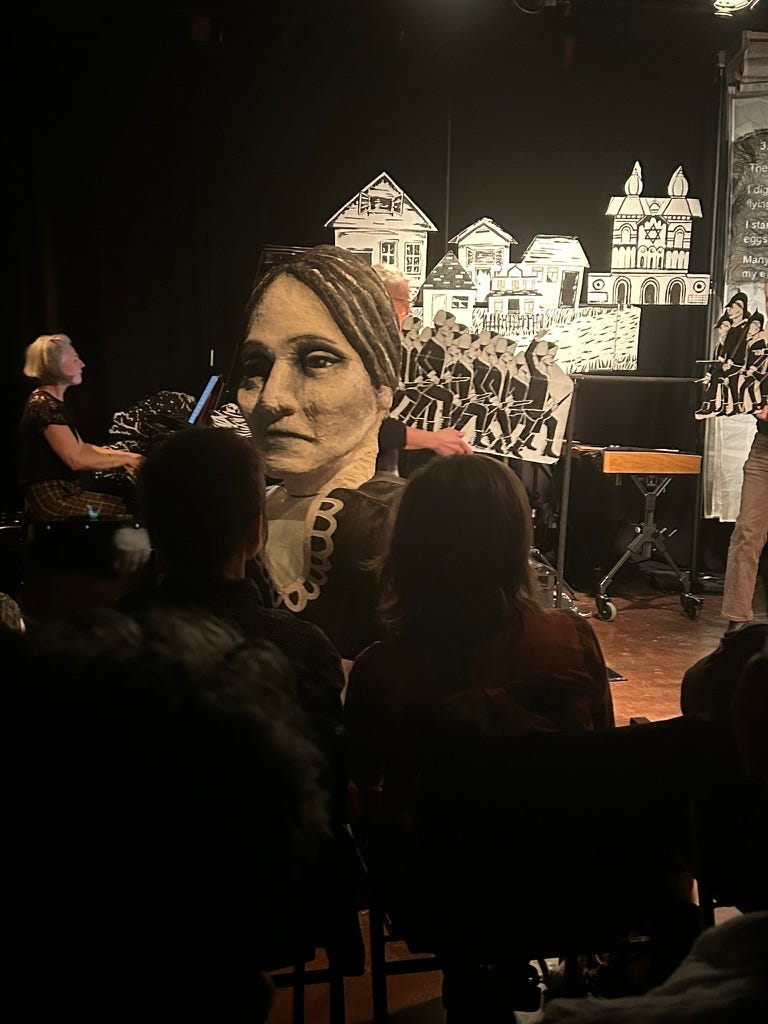
I snagged a ticket to the world premier (in a teeny tiny theatre) of In Perpetual Motion—part piano performance, part puppet theatre (but not the hand puppets you’re thinking of—see pic above).
It featured Lisa Kaplan, someone I’ve gotten to know personally over the past couple of years but hadn’t had the absolute awe of hearing her play (despite the fact that she’s the founder and four-time Grammy Award-winning pianist of Eighth Blackbird.) My mind was officially blown when she paired up with her friend Matthew Duvall to play four-handed piano—plus fists and elbows—and somehow coaxed an astonishingly rich, layered, and fun percussive soundscape out of a single piano.
The puppet show told the immigration story of Lisa’s great-grandmother, Esther Kaplan after surviving WWI in Eastern Europe. It was based on the words from Esther’s journals and the puppets were created by Blair Thomas, the Founder and Artistic Director of The Chicago International Puppet Theater Festival . If you’ve never seen one of his shows, find one and go. You will see things you did not know puppets could do.
I met the Mexican American artist and writer Suzy Bielak at a friend’s party and we got to talking about feminism and art and witches. Her work explores migration, displacement, memory, and place and she invited me to her gallery show which featured paintings, visual poems, photographs, needlefelt works and a wall full of suspended broom forms she made herself out of thousands of twigs collected from around Chicago. Find the women out there doing cool things. There are many!
Last February, I joined Celeste Davis’s inaugural Women’s Circle where once a month a bunch of interesting people get together online to chat. Using a piece of media as a jumping-off point, we discuss women, power, relationships, identity, and patriarchal culture in our everyday lives. I can’t believe I never saw the movie Good Luck to You Leo Grande before this group! If you’re lucky, Celeste will open up this group again next February.
My friend, the blues guitarist Dave Specter, put together a benefit concert called Songs of Protest, Sounds of Freedom. Damn, I forgot how powerful protest music can be3. There is something different about hearing songs of resistance with other people in a room than reading about resistance or doomscrolling your way through another depressing news cycle. Music can hold anger and grief, but it can also turn those feelings into something communal—and even joyful. Chicago talent like Billy Branch, Lynne Jordan, Melody Angel and many others came to sing their hearts out and donated the proceeds to The Illinois Coalition For Immigrant & Refugee Rights.
If you’ve got an extra three minutes to enjoy these talented musicians and listen to their words, I posted a montage of it on instagram:
I also attended multiple author talks, in large venues and tiny bookstores. I attend because I like supporting authors, of course, but also because I enjoy hearing the behind-the-scenes scoop from other authors. And I always end up meeting interesting people.
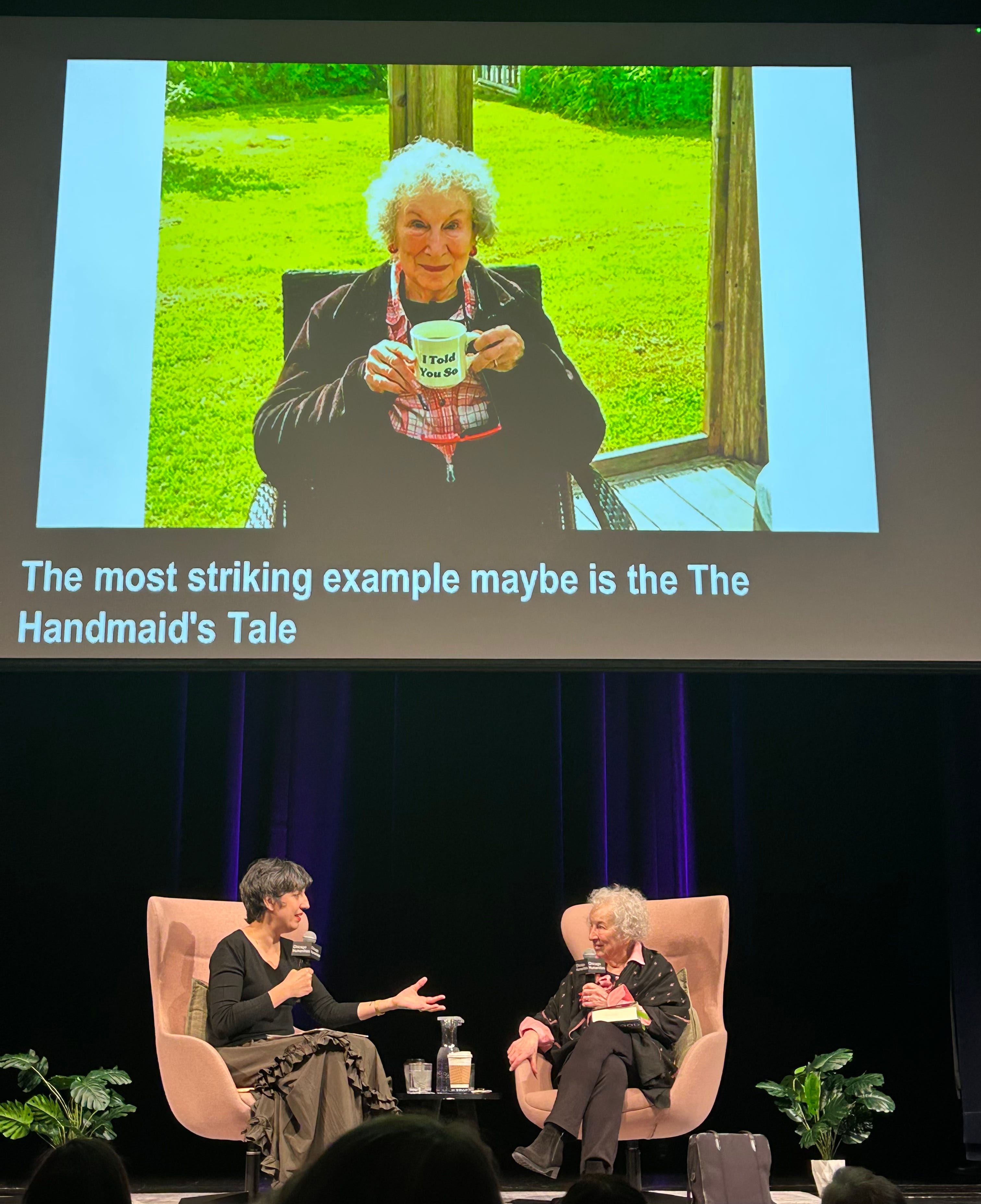
I saw Margaret Atwood talk about Book of Lives: A Memoir of Sorts. As a huge fan of her books (I still have my copy of Cat’s Eye from when I was 19 signed by her to my mother) and of the TV version of The Handmaid’s Tale, it was an incredible treat. I learned that we went to the same summer camp in Canada—many years apart—where she earned her nickname “Peggy Nature.”
I also attended book talks with Stephanie Fairyington, author of Ugly: A Letter to My Daughter, and Rebecca Morrison, author of The Blue Dress (which I wrote about here.) One is an adult nonfiction book and the other a middle-grade novel. Both are memoiristic and explore the destructive culture girls are steeped in with its relentless focus on their appearance.
I had a great conversation with Stephanie and her conversation partner, Renee Engeln. Renee is the author of Beauty Sick: How the Cultural Obsession with Appearance Hurts Girls and Women—a book I quote often in my own book, Sexism and Sensibility. Renee is also a subscriber to this newsletter, and now Stephanie is too (yay), so meeting these brilliant people in person was a real privilege!
I took great pleasure in being in a room full of people who had come together because they cared about women’s stories. There’s a particular kind of feminist joy in hearing a woman talk about something she has spent years thinking about and then turning around and telling other women about it.
And this is another thing I’ve realized: feminist joy is contagious. One woman’s book leads you to another woman’s book, which leads you to an author event, where you meet another woman whose work you want to read. One good thing keeps leading to another. That’s actually how I ended up reading a bunch of middle-grade novels as research for my own potential MG novel (shh, I’m not sure yet if I have the chops for fiction).
Here are four middle-grade novels I highly recommend for the young girls in your life. They deal beautifully with topics like gender bias, sexual harassment, grooming and objectification. I’ve added them to my Bookshop.org list as well as to the Resources and Recommendations page on my website:
Dress Coded by Carrie Firestone
Listen To The Girls by Chrystal D. Giles
The Prettiest by Brigit Young
Maybe He Just Likes You by Barbara Dee
And I would be remiss if I didn’t mention the fabulous feminist shows I’ve streamed over the past few months:
Handmaid’s Tale—obviously (dark dystopian)
Furious (crime drama —Epstein-esque)
Dietland (dark comedy drama)
Bad Sisters (Irish black comedy)
This Way Up (British comedy-drama)
Better Things (comedy drama and one of my all-time faves)
Somebody Somewhere (comedy-drama)
Dying for Sex (comedy drama miniseries)
We are allowed to know exactly how bad things are and still have a great fucking time. Or at the very least take a break and dissociate for awhile. We don't fight the muck by staring at it all day. We fight it, in part, by filling our lives with evidence that women are creating, connecting, making art, telling stories, building communities, and having a hell of a good time. And every time we show up for a woman (or any ally) who is making something—buy the ticket, read the book, go to the concert, visit the gallery, subscribe to the newsletter, fill the seats at the theater—we are also helping create the kind of culture we want to live in.
So get out of the doomscroll and go find some women doing cool shit. And PLEASE, share in the comments what feminist joy you’ve been findng!
P.S. For those in Chicagoland, you might just find Camaraderie and feminist joy at Hot Flashes & Fierce Tales — a night of storytelling, Wed Oct 14, 7:00 PM - 8:45 PM The Skokie Theatre, 7924 Lincoln Ave., Skokie, IL, 60077
🌟 SPECIAL OFFER — Only 9 days left 🌟
TLDR:
Buy TWO NEW HARDCOVER copies of Sexism & Sensibility, and I’ll give you a FREE LIFETIME paid subscription to my Substack, Raising Her Voice.
Buy ONE and I’ll comp you a FREE ONE-YEAR paid subscription.
WHY
The two-year anniversary of Sexism & Sensibility fell on the same day we lost Gloria Steinem.
When I realized the dates had collided, I kept thinking about that coincidence. Here I was, two years after publishing a book about raising girls to recognize sexism, challenge limiting expectations, and find their voices—and on that very day, we were saying goodbye to a woman who had spent her life doing exactly that.
It made me think about how feminist ideas move through the world: from one person to another, across generations, through books and conversations and the voices of people who refuse to let them disappear.
And it made me want to do something small to mark the moment.
THE OFFER
Buy two hardcover copies of Sexism & Sensibility and I’ll give you a FREE LIFETIME paid subscription to Raising Her Voice.
Keep one copy for yourself, and give the second to a friend, a coworker, a teacher, an older teenager, or a local library (or even a Little Free Library!). The idea is to get feminist ideas into the world and to keep them circulating.
You can buy the book on Amazon or Bookshop or anywhere else. Just message me with a copy of your receipt, and I’ll take care of the subscription.
ONLY WANT TO BUY ONE COPY?
A few people have asked if they can participate without buying two books, so I’m happy to offer this option, too:
Buy one hardcover copy of Sexism & Sensibility and I’ll comp you a FREE ONE-YEAR paid subscription to Raising Her Voice.
——
These offers are good for both free and already-paying subscribers. If you’re already paying, your recurring charges will stop once I add your complimentary subscription.
You can also choose to gift the lifetime subscription to a friend—just let me know when you send your receipt.
Thank you. Truly. Every book purchase helps my work—and feminist ideas—reach more people. Changing a culture is a collective effort, and every book, conversation, and voice helps move it forward.
Thank you, Gloria, for raising your voice—and inspiring so many of us to raise ours.
XO Jo-Ann

⭐⭐⭐⭐⭐ 4.9 on Amazon
⭐⭐⭐⭐⭐ 4.6 on Goodreads
“If you’re raising a girl, loving a girl, teaching a girl, or trying to undo some of what the world taught you when you were one, Dr. Finkelstein is a voice worth listening to.”
— Most recent reader review
Related Posts
On Words, Womanhood, and Showing Up

We can’t forget that difficult times bring misinformation, with revisionist narratives that erase the inconvenient truths. But when women write, we preserve reality. We make sure that future generations don’t just hear the dominant story—they hear our story.
Eyes Wide Open: How Women's Vigilance Could Spark Change

We know that strong social support networks can help buffer the impact of stress, and when it comes to misogyny, supportive women can create spaces for each other where experiences are validated, strategies shared, and collective action organized. But do you know what else supportive women’s networks can be? Launching pads for strategic civil disobedience.
Dolly and Gloria’s Beauty Secrets

Dolly Parton and Gloria Steinem took opposite approaches to femininity. But both understood the rules women were being asked to follow—and refused to play by them.
Lucy has become a regular with Indigo Girls now in part because of Emily’s vocal/movement difficulties have affected her ability to perform the duo’s harmonies. Emily was very candid about how Lucy helps with the notes she can no longer hold.
The name Lilith was chosen because according to medieval Jewish folklore, Lilith was Adam’s first wife who fled the Garden of Eden because she did not want to submit to Adam.
Fun Fact: I’m in this music video for Specter’s protest song, How Low Can One Man Go. (Can you guess who that one man is?).
