


Last week was brutal—losing two of the most badass women of our time, Dolly Parton and Gloria Steinem. As others have pointed out, the Grim Reaper might have chosen better (cough Mitch Mc cough) but alas, we don’t get a say in whether those bad patriarchs get taken or those good matriarchs do.
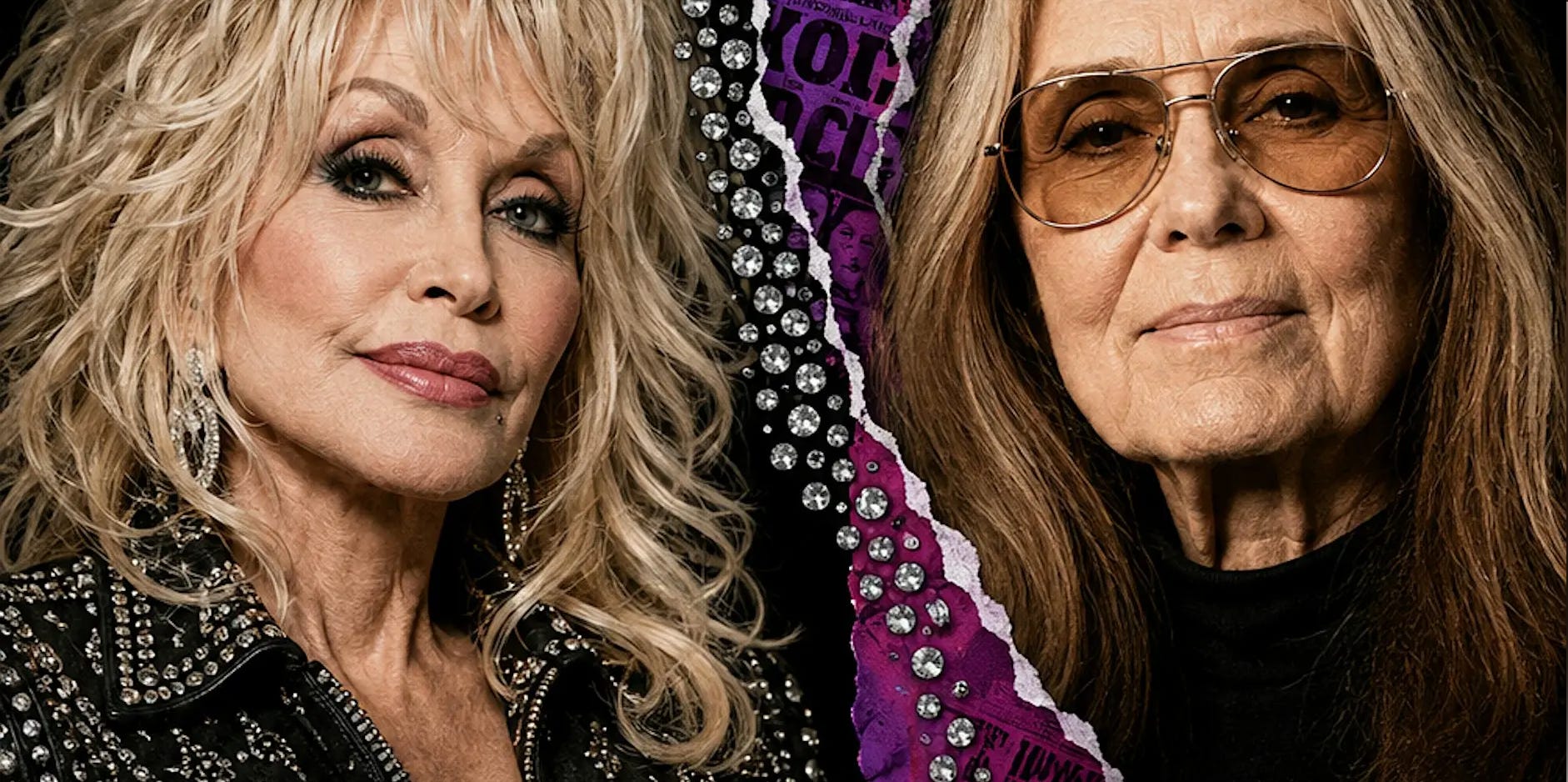
When a friend texted me first thing Thursday morning alerting me to Steinem’s passing, writing simply: “Gloria. 😔”, it felt like a gut punch. I could tell you about my one glorious Gloria encounter and eulogize both her and Dolly for their incredible work advancing women’s rights and voices, but that’s been done a lot already by people closer to them. Instead, I want to focus on how their very different ideas about beauty and lookism were actually two sides of the same defiant coin.
They both understood beauty as a form of social control, but Dolly subverted it from within while Gloria challenged it from the outside.
Dolly wasn’t just feminine. She went to great lengths to elaborate and exaggerate her femininity through big hair, big breasts, tiny waist, makeup, rhinestones, and tight, frilly clothing. She was open about her many cosmetic procedures and surgeries and famously said on Larry King Live, “If I see something sagging, dragging or bagging, I’m going to go have it stuck, tucked or plucked.”
They both understood beauty as a form of social control, but Dolly subverted it from within while Gloria challenged it from the outside.
She pushed the feminine ideal to the point of parody so the artificiality of it became impossible to miss, and she was mocked mercilessly by some for it. Early in her career, people called her “cheap” and wanted her to make everything about her appearance smaller. They questioned whether she could be taken seriously looking as she did. But she never caved. As a child she’d admired a woman—one of the few she saw not mired in childcare and housework—who others called trashy and she’d say, “Well, that’s what I’m gonna be when I grow up.”
She was doing things her way and was sincere about her look. “If I hadn’t been a girl,” she said, “I’d have been a drag queen.” But she also seemed to be performing femininity for another reason. When she famously said, “It takes a lot of money to look this cheap” she was saying You want a woman to look like this? Fine. But I’ll decide exactly how much, and then turned the volume all the way up.
By taking the rules for women and exaggerating them without apology, she revealed both the construction of gender and the labor behind femininity.1 To me, it was a declaration of self-possession: people could judge the surface however they wanted, but they had no authority over the woman beneath it.
Gloria, meanwhile, had her feminist awakening in a moment when women’s beauty was understood as one of the primary mechanisms through which women were disciplined: Be sexy, but not sexual; feminine, but not vain; desirable, but don’t admit you care about being desirable. She fought against the objectification of women. When she started to make a name for herself in the feminist movement, she was surprised to hear herself referred to as “the pretty one.” She understood the media’s fixation on women’s appearance as a way to diminish feminism and divide feminists, but it was painful, nonetheless, to have her work discounted because of how she looked.
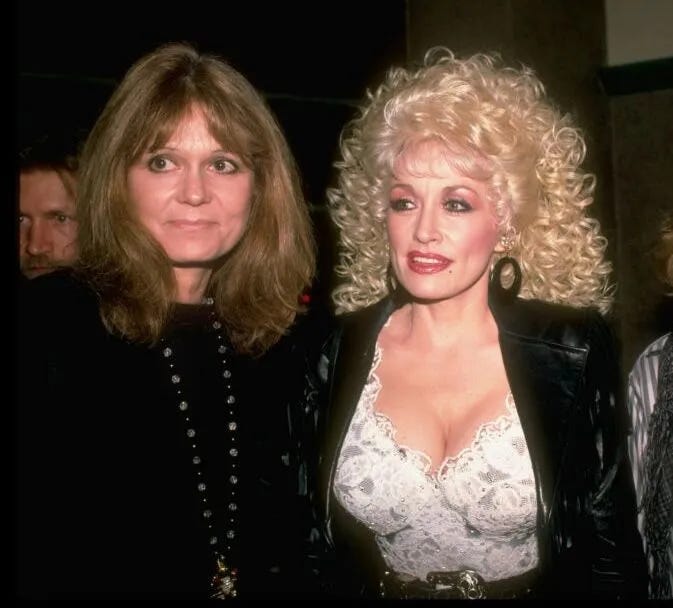
Gloria was judged for being beautiful, when she wanted to be judged for her ideas. Dolly was judged for embodying femininity too loudly to be taken seriously. Both, in their own ways, said, Watch what I do anyway.
The problem isn’t being considered beautiful—or ugly. It’s having your appearance considered before you’re considered anything else.
As Stephanie Fairyington, author of Ugly: A Letter to My Daughter, wrote on her instagram post about Gloria, “…the compliment is also the insult -- whether your considered pretty or ugly the takeaway is always the same: You [sic] job is to deliver on the imperative to be pretty....and then if you do, then they'll think you're less intelligent.”
As Gloria put it in a 2011 interview with Teen Vogue, “There is the notion that an attractive woman, whatever that means in society, a pretty girl can’t be smart. We are still identified by our looks instead of our hearts or heads. That’s why it’s much better to break the rules. If the rules worked, we’d be able to see it. If women were able to sleep to the top, there would be many more women at the top.”
“That’s why it’s much better to break the rules. If the rules worked, we’d be able to see it.”
Both of these women transcended their appearance becoming role models to activists, dreamers and women across the world.2 Dolly didn’t call herself a feminist but as Gloria writes in an essay, penned in 1987 after Ms. Magazine named the singer one of its Women of the Year: “If feminism means each of us finding your unique power, and helping other women do the same, Dolly Parton certainly has done both.”
Despite avoiding partisan politics, Dolly from Tennessee stood up for queer and trans people, and for women’s rights. She lifted up working women and poor communities. She spoke out against racism, saying, “…of course Black lives matter. Do we think our little white asses are the only ones that matter? No!” She also put her money where her mouth was. And, of course, she used her crystalline voice to make heartbreak, humor, faith, and resilience feel universal.
Gloria, an outspoken liberal democrat from New York, spent decades building a deeply inclusive, ground-up vision of feminism—one that understood women’s liberation as inseparable from racial and economic justice.3 She helped build institutions and movements that amplified women’s voices, from Ms. magazine to the National Women’s Political Caucus and the Women’s Media Center, and she helped bring feminism into the lives of girls through Take Our Daughters to Work Day. Even at the end of her life, she was thinking about how to keep people gathering and organizing, placing her home in a trust to ensure her famous living room remains a space to share ideas and build community after she was gone.
Dolly used culture and celebrity to make room for people who were pushed to the margins. Gloria used organizing and activism to change the structures that pushed them there. Both refused to let other people dictate what a woman had to look like—and both spent their lives making the world bigger for others.
Now that’s what I call beautiful!
🌟 SPECIAL OFFER 🌟
TLDR:
Buy TWO NEW HARDCOVER copies of Sexism & Sensibility, and I’ll give you a FREE LIFETIME paid subscription to my Substack, Raising Her Voice.
Buy ONE and I’ll comp you a FREE ONE-YEAR paid subscription.
WHY
The two-year anniversary of Sexism & Sensibility fell on the same day we lost Gloria Steinem.
When I realized the dates had collided, I kept thinking about that coincidence. Here I was, two years after publishing a book about raising girls to recognize sexism, challenge limiting expectations, and find their voices—and on that very day, we were saying goodbye to a woman who had spent her life doing exactly that.
It made me think about how feminist ideas move through the world: from one person to another, across generations, through books and conversations and the voices of people who refuse to let them disappear.
And it made me want to do something small to mark the moment.
THE OFFER
Buy two hardcover copies of Sexism & Sensibility and I’ll give you a FREE LIFETIME paid subscription to Raising Her Voice.
Keep one copy for yourself, and give the second to a friend, a coworker, a teacher, an older teenager, or a local library (or even a Little Free Library!). The idea is to get feminist ideas into the world and to keep them circulating.
You can buy the book on Amazon or Bookshop or anywhere else. Just message me with a copy of your receipt, and I’ll take care of the subscription.
ONLY WANT TO BUY ONE COPY?
A few people have asked if they can participate without buying two books, so I’m happy to offer this option, too:
Buy one hardcover copy of Sexism & Sensibility and I’ll comp you a FREE ONE-YEAR paid subscription to Raising Her Voice.
——
These offers are good for both free and already-paying subscribers. If you’re already paying, your recurring charges will stop once I add your complimentary subscription.
You can also choose to gift the lifetime subscription to a friend—just let me know when you send your receipt.
Thank you. Truly. Every book purchase helps my work—and feminist ideas—reach more people. Changing a culture is a collective effort, and every book, conversation, and voice helps move it forward.
Thank you, Gloria, for raising your voice—and inspiring so many of us to raise ours.
XO Jo-Ann

⭐⭐⭐⭐⭐ 4.9 on Amazon
⭐⭐⭐⭐⭐ 4.6 on Goodreads
“If you’re raising a girl, loving a girl, teaching a girl, or trying to undo some of what the world taught you when you were one, Dr. Finkelstein is a voice worth listening to.”
— Most recent reader review
That’s almost the opposite of contemporary beauty culture, which increasingly demands that women look effortlessly beautiful while concealing the enormous labor required to achieve it.
When I met Gloria Steinem, I told her that, in many ways, she’d raised me. It’s worth noting that neither she nor Dolly had children so for those who say women without children have no legacy or impact [INSERT BLOWING RASPBERRY EMOJI HERE]
Gloria Steinem, like the rest of us, was human and had her flaws. But despite the ignorant criticism flying around, she was deeply intersectional. Read Kate Manne’s piece about it here.
RELATED POSTS
You Should Grow Your (Body) Hair

I’m not in the habit of telling women what to do with their bodies. But if you’ve been feeling a vague, sick helplessness in the face of the astonishing fuckery surrounding Jeffrey Epstein, the rhetoric of Nick Fuentes, and the steady legal erosion of bodily autonomy, growing your body hair is one small, immediate way to make the personal political.
This is Your Brain on Sexism

When women describe how sexism affects them, the response is often, “It’s all in your head.” Well, now they can say, “Yes, it is. It’s literally in my brain.” A groundbreaking study examining over 7,800 brain scans from men and women across 29 countries revealed that women exposed to sexism show real, measurable changes in brain structure.
Why Your Daughter’s Version of Body Autonomy Might Look Different Than Yours

My daughter, like me, is deeply attached to the mantra “my body, my choice.” For me, that mostly conjures reproductive rights and the ability to move safely through the world. To her, it means free rein to bare her midriff and whatever else, when she so pleases. It’s true, female bodies have been subject to evaluation and blame for far too long. It’s also true, as I once said to her, sometimes a cigar is just a cigar but a crop top, dieting, or Brazilian wax are never as simple as free choice.
It's Not Your Job to Be Pretty

There is a moment in most parents’ lives when they witness in a concrete way that the world has begun its work on their daughters. The messages arrive through screens and storefronts and offhand comments and inappropriate stares, through the architecture of social media and the subtle tyranny of the algorithm. By the time their daughter is standing in front of a mirror getting ready for school, she has already absorbed more noise about what she is supposed to look like than either of them can consciously know.
